Independent Review Notice: All product recommendations are selected independently by our team. We may earn an affiliate commission when you purchase through links on our site.
Using Starlink while the vehicle is moving is the dream scenario for RVers and overlanders: navigation, streaming, and video calls running from the passenger seat. The reality is more nuanced — in-motion service is plan-and-hardware dependent, and bolting a dish to a moving roof without the right kit ends with cracked mounts and dead cables. Here’s what actually works, what doesn’t, and the gear that makes the difference.
| Product | Best For | Key Features | Price |
|---|---|---|---|
 | Best Fixed Mount - Low-Profile Flat RV Mount |
| Check Price on Amazon |
 | Best Power Upgrade - Hardwired 12V Conversion Kit |
| Check Price on Amazon |
| Best Portable Option - Magnetic Base Mount |
| Check Price on Amazon |
First, the Plan and Hardware Gate
Before any hardware talk, understand the two gates:
- Plan gate: Roam Unlimited (or a Priority-tier plan) is required for in-motion operation. Regional Roam and Residential plans will not sustain a moving-vehicle connection.
- Hardware gate: in-motion tracking needs a dish designed for it. The Flat High Performance antenna is the official in-motion hardware, with a wide 140-degree field of view and a low-profile form built for vehicle roofs. The Mini occupies a middle ground: not officially rated for highway-speed tracking, but excellent for stationary use on a stopped rig, camp, or tailgate.
The standard Gen 2 and Gen 3 dishes use motorized-positioning-free wide beams but were not designed for sustained motion at speed — think of them as stationary hardware that happens to travel with you.
What In-Motion Use Actually Delivers
Real-world expectations from Roam Unlimited with appropriate hardware:
- Downlink — typically 50–150 Mbps at highway speed in covered cells, dipping during handoffs and in tree-heavy corridors.
- Latency — median holds around 40–70 ms while moving; occasional 200 ms+ spikes during satellite swaps.
- The tree problem — no plan or dish solves foliage. Under a closed canopy the connection drops within seconds; open highway and desert travel is where in-motion shines.
- Power draw — Flat High Performance units run hot and hungry: 110–150W sustained, more with the heater active. Budget accordingly.
Mounting for Motion: Physics Before Products
A moving roof is a brutal environment: vibration, wind loading at 70 mph, thermal cycling, and car-wash brushes. Mounting choices in rough order of permanence:
Low-profile flat mounts
The standard solution for permanent installs. These sit under 2 inches above the roofline — critical for wind loading, gas-station clearances, and stealth. Quality kits use both structural adhesive and fasteners; adhesive-only installs on composite RV roofs are the failure pattern we see most. Route the cable through a sealed gland, not a window gap — see our pass-through guide.
Check Price on Amazon: Low-Profile Flat Mounts
Magnetic bases — for the honest portable use case
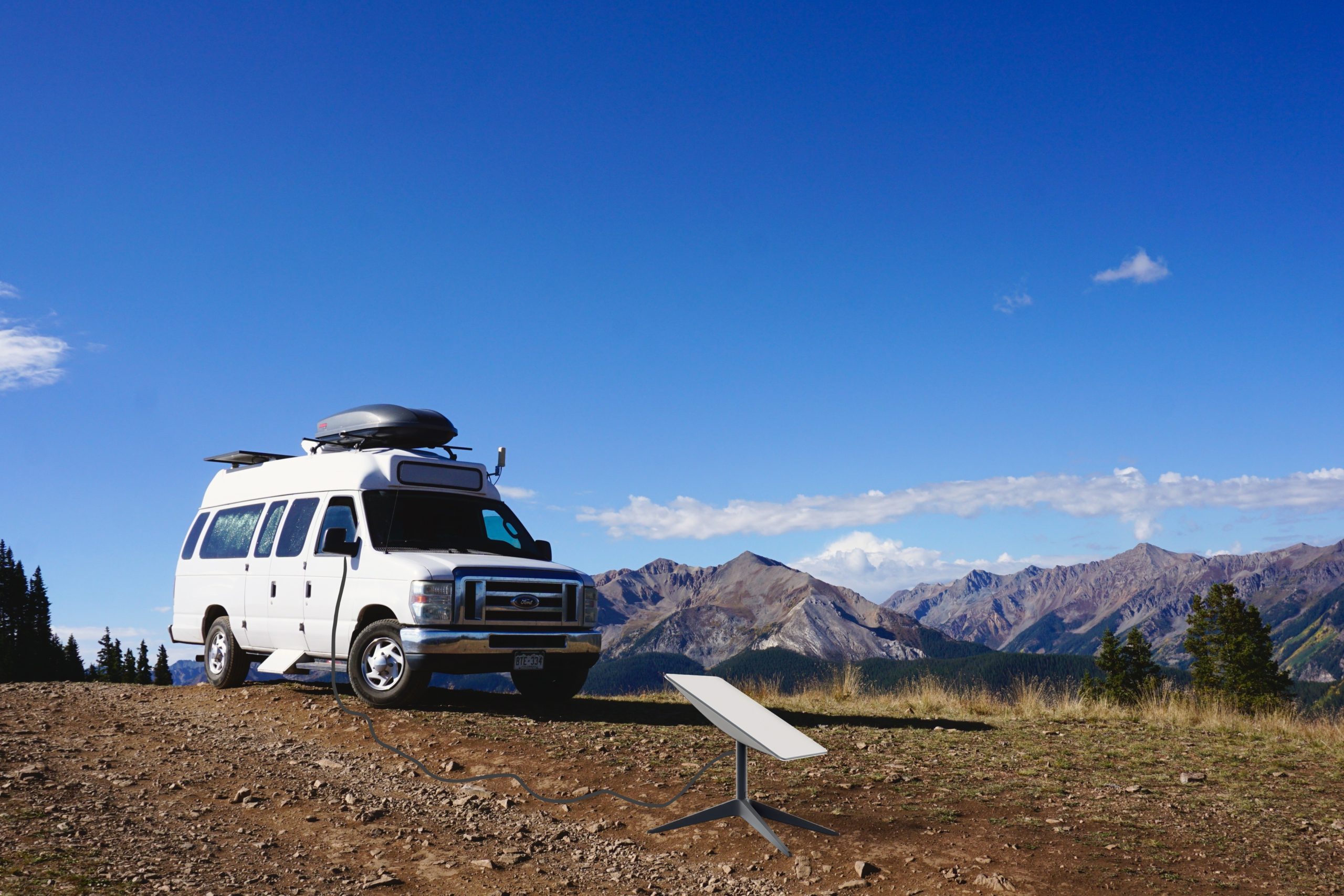
A heavy-duty magnetic base (120 lb pull class) on a steel roof is the honest middle ground: it’s genuinely secure at highway speed for a stationary-use dish you set up at camp, and it moves between vehicles in minutes. We recommend it for Mini and Gen 2/3 users whose “mobile” use is really “stop, deploy, enjoy” — not true in-motion tracking.
Check Price on Amazon: Magnetic Bases
Roof rack and ladder mounts
For rigs with existing racks, a clamp-on ladder or rack mount keeps the dish high and clear — our RV ladder mount comparison tested the leading options for wind stability and tool-free installation. Position the dish for a clear sky view while parked; parked stationary use is what these mounts are for.
Powering In-Motion Setups
Running a dish off a running vehicle’s 12V system is straightforward with a hardwired 12V conversion kit — fused, properly gauged, and tapped to an ignition-switched or always-hot circuit depending on whether you want the dish live without the engine. The conversion skips the inverter entirely, cutting total consumption by roughly 30% versus the stock AC brick. Wiring specifics, voltage tolerances (Gen 3 expects 54V from its PSU, so use a proper boost converter, not raw 12V), and fuse sizing are in our 12V conversion guide.
Check Price on Amazon: 12V Conversion Kits
For setups where the dish runs while parked for days, a LiFePO4 house battery plus solar is the cleaner architecture — the sizing math lives in our off-grid guide.
Legal and Practical Notes
- Driver screens only. In-motion connectivity is for passengers. A dish streaming Netflix to the driver is illegal everywhere — this should go without saying, but it’s the first thing insurance adjusters ask about.
- Height clearances. A standard dish on a tall mount adds meaningful height; low-profile flat mounts keep you under typical 13’6″ bridge limits on most RV platforms.
- Car washes. No magnetic or clamp mount survives an automated car wash. Retract or remove first.
Verdict: Match the Kit to Your Truthful Use Case
If you genuinely need connectivity at highway speed, that’s Flat High Performance on Roam Unlimited, hardwired power, and a bonded low-profile mount — a $2,000+ commitment that delivers. If your life is “drive to camp, then get online,” a Mini or standard dish with a magnetic base and a power station delivers 90% of the experience at a third of the cost. Buy for the use case you actually have.