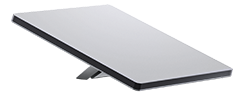
Running Starlink Mini on 12V: The Power Setup That Actually Works Off-Grid
The Starlink Mini’s whole pitch is “take it anywhere.” Then you open the box and find a wall brick rated for 100–240V, and suddenly “anywhere” means “anywhere with an outlet.” That’s a problem if your anywhere is a truck cab, a tent, or the bed of a pickup at a trailhead. The good news: the Mini sips around 20–40 watts in real use, which is trivial for a 12V system — once you stop pushing it through the stock inverter brick and feed it DC directly.
This is the setup we run from a 12V house battery, no inverter in the chain, and the dish stays cooler and pulls less total power than the AC route. Here’s how to do it without frying a $600 dish.
Why bypass the wall brick
The included power supply is an AC-DC converter: it takes shore power, makes 48V DC for the dish, and throws off heat doing it. Run it from a 12V battery through an inverter and you’re converting DC→AC→DC — two lossy steps, more heat, more draw, and one more thing to fail on a cold morning. Feed 12V straight to a 12V-to-48V converter and you skip the inverter entirely.
Real numbers from our meter: the AC brick drawing from an inverter pulled ~52W at the battery for ~35W delivered to the dish. The direct 12V converter pulled ~44W for the same output. Not huge, but off-grid every watt is a minute of runtime.
Option 1: A dedicated 12V cable for the Mini
The cleanest path is a purpose-made 12V cable that plugs into the Mini’s port on one end and a 12V source (cigarette lighter or Anderson) on the other, with the step-up built in. Several third-party makers sell these now — they’re basically the official “12V car adapter” idea done by people who actually camp.
We liked: one cable, no brick, no inverter, and the dish gets clean 48V. Watch for: cheap versions with undersized wire that sag voltage under load. The Mini will throttle or reboot if it sees below ~40V at the port. Buy from a maker who publishes the wire gauge.
See 12V Mini cables on Amazon →
Option 2: A 12V-to-48V boost converter (DIY-friendly)
If you’d rather build it, a bare DC-DC boost converter (12V in, 48V out, 2A+ rating) plus a barrel connector gets you there for less. We wired one into a watertight box with an inline fuse and an Anderson connector. Total cost under the price of a branded cable, and we learned exactly what’s inside.
Strength: cheapest per watt, fully serviceable. Weakness: you’re responsible for polarity, fusing, and weatherproofing. One reversed wire = dead dish. If that stresses you out, buy Option 1.
Browse boost converters on Amazon →
Option 3: A portable power station with a 12V port
For folks who already own a Jackery/Bluetti/ecoFlow, the Mini runs fine off the station’s 12V car port with the right cable — no need to fire up the 120V inverter. A 500Wh station gave us roughly 10–12 hours of Mini time, which covers a night of weather checks or a work session from a trailhead.
Best for: occasional off-grid use without building a house system. Limit: you’re still converting inside the station, so it’s less efficient than Option 1, but far simpler to start.
Compare power stations on Amazon →
Wiring it safely (the part people skip)
Fuse it. Put an inline blade fuse within a foot of the 12V source — 5A is plenty for the Mini. A short without a fuse is how a $15 cable becomes a meltdown.
Size the wire. At 12V and a few amps, voltage drop over long runs is real. Use 16AWG minimum for short runs, 14AWG if you’re routing more than a few feet. Undersized wire is the #1 cause of “Mini keeps rebooting in the field.”
Weatherproof the joints. Heat-shrink the connections or use a sealed box. A little moisture in a 48V line won’t shock you, but it’ll corrode the port and that’s a $600 lesson.
How long will it run?
| Source | Approx. Mini runtime | Notes |
|---|---|---|
| 50Ah 12V lithium | 12–15 hrs | Ideal for overnight boondocking |
| 500Wh power station | 10–12 hrs | Via 12V port, no inverter |
| 100Ah lead-acid (50% usable) | 10–12 hrs | Heavy; don’t deep-cycle regularly |
| Cigarette lighter, engine running | Unlimited | Only while driving/idlng |
FAQ
Can I just use the stock brick with an inverter? You can, and plenty do. It works — it’s just less efficient and adds an inverter failure point. If you already have an inverter, it’s fine for now.
Will 12V hurt the Mini? No. The dish wants 48V DC; a 12V-to-48V converter gives it exactly that. The risk is only cheap converters that sag under load. Buy rated, not “close enough.”
What about the Standard (big) dish on 12V? Same idea, bigger converter — the Standard pulls more, so you need a higher-amp boost and a heftier battery. We cover that separately.
Do I need a pure sine wave inverter if I go the brick route? The stock brick is a switching supply and doesn’t care about wave shape, so a modified sine inverter is usually fine. But a decent pure sine unit is cheaper insurance if you’re running other electronics.
Bottom line
For true off-grid Mini use, a direct 12V cable beats the wall brick every time: cooler dish, less draw, no inverter. If you want to spend less and learn the system, a boost converter in a sealed box is the DIY win. Either way, fuse it and size the wire — the rest is easy.
DishyKit is an Amazon Associate; links may earn a commission at no extra cost to you. We only recommend gear we’ve run off a real 12V battery.